Smith County family court records contain case details related to domestic matters handled in the county court system. These records may include divorce filings, child custody arrangements, adoption cases, and support orders recorded through official court proceedings. Legal professionals, researchers, and residents often use these documents for case verification and reference. Each record reflects filings, hearings, and final judgments maintained by the court clerk’s office, offering structured documentation of family-related legal matters within Smith County jurisdiction. They help maintain accurate legal history for official record keeping purposes.
Smith County family court records are official documents that reflect legal proceedings involving family matters such as divorce disputes, child custody rulings, guardianship, and support agreements. These records are maintained through the county courthouse system and include filings submitted by parties along with court decisions issued by judges. Attorneys and local residents review these documents for case reference and legal verification. Each entry provides chronological case history stored within county archives for administrative recordkeeping and legal reference use. Records support consistent documentation of family law proceedings.
How to Search Smith County Family Court Hearings
Smith County provides public access to court hearing schedules through its online Hearings Search portal. This tool allows users to locate scheduled hearings by selecting a court location, hearing type, search type, and date range. Family court users can use the system to review available hearing schedules and court calendar information for family-related proceedings. The county provides access to its official records including Judicial / Jail Records resources, through its official website and hearing search portal.
Open the Official Hearing Search Portal
Begin by opening the official Smith County Hearings Search page: https://portal.smith-county.com/Public/Home/Dashboard/26
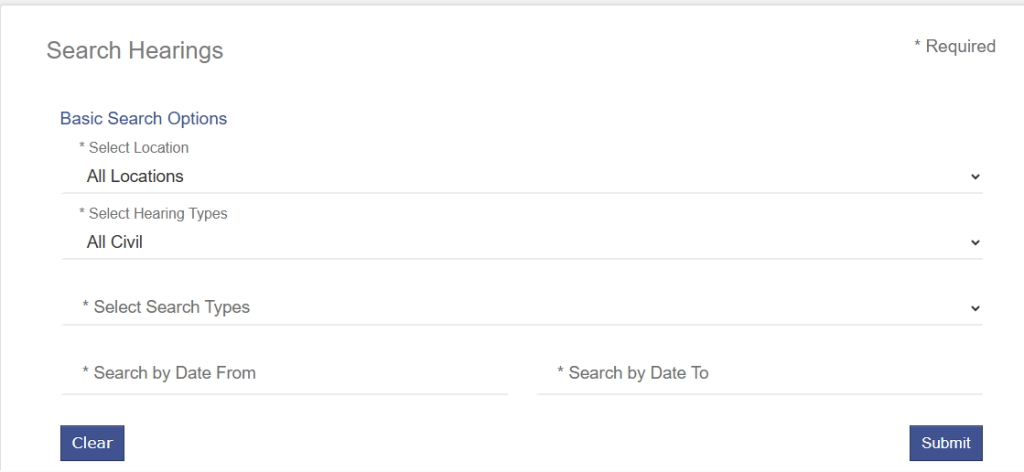
The Search Hearings dashboard contains the filters required to locate public hearing schedules and court calendar information.
- Open the official hearing search portal
- Access the Search Hearings dashboard
- Review the available search filters
- Prepare the information needed for your search
Select a Court Location
The first required field is the Location filter.
Users can:
- Select All Locations to search across all available courts
- Choose a specific court location when known
- Narrow results to a particular courthouse
- Improve search accuracy by limiting the search area
Selecting a specific location often helps reduce the number of unrelated hearing results.
Choose a Hearing Type
The Hearing Types dropdown allows users to narrow results by hearing category.
Steps:
- Open the Hearing Types menu.
- Select the category that best matches the hearing you want to locate.
- Continue to the next search filter.
- Review results that match the selected hearing category.
Using a hearing type filter helps users focus on relevant court schedules.
Select a Search Type
The Search Types dropdown determines how hearing records are searched within the system.
To use this filter:
- Open the Search Types menu.
- Select an available search option.
- Continue entering the remaining search criteria.
- Use the selected search method to refine hearing results.
Available search options may vary depending on the selected hearing type.
Enter the Date Range
The hearing search form requires a date range.
Search by Date From
Enter the beginning date of the period you want to search.
Search by Date To
Enter the ending date of the period you want to search.
Date filters can help users:
- Search upcoming hearings
- Review recent hearing schedules
- View court calendars for a specific period
- Narrow large result sets
Submit the Search
After completing all required fields:
- Review the selected filters.
- Verify the date range.
- Click Submit.
- Wait for the system to generate results.
The portal will display hearings that match the selected criteria.
Clear Search Filters
If you want to perform a new search:
- Click Clear.
- Remove all previously selected filters.
- Enter new search criteria.
- Submit the search again.
Review Hearing Results
The results page displays hearings that match the selected search criteria.
Available information may include:
- Hearing date
- Hearing time
- Court location
- Hearing type
- Court division
- Scheduling details
- Additional court calendar information
Types of Family Court Cases in Smith County
Family court cases in Smith County cover legal matters linked with family relationships, responsibilities, and disputes. The domestic relations court handles issues that involve children, marriage breakdown, and parental duties, while some related procedural matters may also pass through the Municipal Court for initial filings or administrative processing. Judges review facts, financial records, and parenting situations before issuing court judgments. Most cases fall under child custody court matters, support obligations, divorce issues, and parental rights disputes. These cases shape custody agreements, parenting plans, and long-term family law disputes that affect both parents and children.
Child Custody Cases
Child custody cases in Smith County focus on where a child lives and how parental responsibilities are shared. The child custody court reviews parenting plans, home conditions, and each parent’s ability to provide stability. Judges examine evidence from both sides before issuing custody decisions. These cases often arise during separation or divorce, and they may change over time if circumstances shift. Custody agreements can include joint arrangements or sole custody, depending on the child’s best interest and family situation presented in court.
Child Support Cases
Child support cases deal with financial responsibility for raising a child after separation or divorce. The domestic relations court reviews income details, expenses, and the child’s needs before setting payment orders. These cases may also include enforcement actions when payments are missed or delayed. Family litigation processes help maintain fairness between both parents while supporting the child’s welfare. Court judgments can be adjusted if income or living conditions change significantly, which often leads to modified support arrangements.
Divorce & Separation Cases
Divorce and separation cases in Smith County involve legal ending of marriage and division of shared responsibilities. The domestic relations court handles property division, financial settlements, and spousal support decisions. These cases often begin with temporary orders that manage finances and living arrangements during proceedings. Judges evaluate documentation and arguments from both sides before issuing final court judgments. Family law disputes in divorce cases often focus on fairness in asset distribution and long-term financial stability for both parties.
Parental Rights Cases
Parental rights cases involve legal authority over a child and may result in major changes to family structure. The court reviews situations such as neglect, abandonment, or unsafe environments before making decisions. In Smith County, the domestic relations court may approve termination of rights or assign guardianship when required. These cases carry long-term impact since they permanently affect custody and parenting rights. Judges focus on child safety, stability, and welfare before issuing final court judgments that redefine parental responsibilities.
Child Custody Court Process in Smith County
Child custody cases in Smith County follow a structured legal process where the court reviews parenting situations and decides what arrangement supports the child best. The parental rights court handles these disputes through filings, hearings, and formal evaluations. Each case moves through steps that include documentation, mediation, and final court judgments. Judges focus on stability, safety, and daily care arrangements before issuing custody decisions. These decisions may affect visitation rights, guardianship, and long-term parenting responsibilities.
How Custody Cases Are Filed
Custody disputes begin when one parent submits a formal petition to the child custody court. This filing starts the legal process and brings the matter under family court jurisdiction. The petition usually includes details about the child, current living arrangements, and requested custody terms. Supporting documents such as financial records or past agreements may also be submitted. Once filed, the other parent receives legal notice and gets a chance to respond through a written reply or counter-petition.
Common filing steps include:
- Submitting custody petition in domestic relations court
- Providing child and parent information
- Sharing existing custody agreements, if any
- Notifying the other parent officially
- Filing response or counter-claims
Mediation Process
Before a full court hearing, many custody disputes move through mediation. This step allows both parents to discuss parenting plans and visitation rights with a neutral mediator. The goal is to reduce conflict and reach a workable agreement without prolonged litigation. The mediator does not issue court judgments but helps structure communication between both parties. If an agreement is reached, it may be submitted to the court for approval. If not, the case continues to hearings.
Key features of mediation include:
- Structured discussions between parents
- Focus on custody agreements and parenting plans
- Review of child needs and routines
- Possible creation of joint custody arrangements
- Reduction of courtroom conflict
Court Hearings
If mediation fails, the case proceeds to a family court hearing. During this stage, both parents present evidence, witnesses, and arguments. The judge evaluates custody evaluation reports, school records, and home environment details. Testimony may include concerns about parenting ability, safety, or stability. Hearings are formal and follow strict court procedures. The judge may also consider recommendations from child welfare professionals when deciding custody disputes.
Court hearing process often includes:
- Presentation of evidence by both parents
- Review of custody evaluation reports
- Witness statements and documentation
- Examination of parental rights court concerns
- Judge questioning and legal arguments
Judge Decisions
After reviewing all evidence, the judge issues a custody ruling. This decision focuses on the child’s well-being, stability, and long-term care. The court may approve joint custody, sole custody, or structured visitation rights. In some cases, legal guardianship may be assigned if needed. The judge’s order becomes legally binding and must be followed by both parents. Violations of the order can lead to enforcement actions through the domestic relations court system.
Possible outcomes include:
- Joint custody arrangements
- Sole custody to one parent
- Defined visitation rights schedule
- Legal guardianship orders
- Enforced parenting plans
Temporary vs Permanent Custody Orders
Custody orders in Smith County may be temporary or permanent depending on the case stage. Temporary custody orders are issued early in the process to provide immediate structure while the case is ongoing. These orders help stabilize the child’s living situation during disputes. Permanent custody orders are issued after final hearings and remain in effect unless modified by the court. Changes may occur if significant life circumstances affect the child’s welfare or parental ability.
Key differences include:
- Temporary orders apply during active cases
- Permanent orders follow final court judgment
- Temporary arrangements focus on immediate stability
- Permanent custody defines long-term parenting structure
- Modifications require new court review
How to Access Child Support Case Records
Child support court records in Smith County contain detailed information about payment obligations, enforcement actions, and case history. These records are stored within the domestic relations court system and related enforcement databases. They help track financial obligations between parents and show whether support orders are being followed. Individuals may review case updates, payment arrears, and modification requests through official court systems. These records also support enforcement cases when payments are missed or disputed.
Where Child Support Records Are Stored
Child support records are maintained by the domestic relations court and linked enforcement agencies. These systems store all case documents, including support orders, payment history, and court judgments. Records may include original filings, income details, and updated rulings. In many cases, enforcement agencies also maintain separate databases to track ongoing payments and arrears. Access may require case numbers or verified identity depending on the request type.
Common record storage points include:
- Domestic relations court archives
- State or county enforcement agency systems
- Online case lookup portals
- Clerk office record systems
- Payment tracking databases
Payment Tracking Systems
Payment tracking systems monitor all child support transactions linked to a case. These systems record when payments are made, missed, or partially completed. They also calculate outstanding balances known as payment arrears. Courts rely on this data to confirm compliance with support orders. In many cases, employers may be instructed to deduct payments directly from wages to reduce delays and improve consistency.
Key features of tracking systems include:
- Monthly payment history logs
- Automatic wage deduction records
- Balance updates for arrears
- Real-time case payment status
- Notification of missed payments
Enforcement Actions
When payments are not made, enforcement agencies step in to collect overdue amounts. These actions are part of support enforcement cases handled through court authority. The agency may take legal steps to recover unpaid financial obligations. Enforcement is designed to ensure children receive consistent financial support. Courts may also review repeated violations and apply stronger penalties when needed.
Common enforcement actions include:
- Wage garnishment orders
- License suspension requests
- Tax refund interception
- Court-issued payment penalties
- Collection agency involvement
Modifications of Support Orders
Child support orders may change when financial or personal circumstances shift. A parent can request a modification through the domestic relations court. Judges review updated income details, employment changes, or changes in custody arrangements. If approved, new support orders replace previous ones. These changes help keep financial obligations fair and aligned with current conditions.
Situations that may lead to modifications:
- Income increase or decrease
- Change in custody arrangements
- Job loss or employment change
- Medical or special needs expenses
- Updated court evaluations
Are Smith County Family Court Records Public?
Smith County family court records are partly public, but not all case details can be viewed by everyone. The domestic relations court allows public court records for general case information, yet sensitive details remain protected under family court privacy rules. Some files are open for basic lookup, while others stay confidential due to child protection concerns or sealed case orders issued by a judge.
What Is Public vs Restricted
Public court records usually include basic case details such as filing dates, case status, and final court judgments. These records help people verify case activity and track general updates within the domestic relations court. Restricted records contain private and sensitive information that stays protected under family court privacy rules. These confidential court records are limited to protect children, families, and ongoing legal matters like custody disputes or child protection cases.
| Public Court Records | Restricted Court Records |
|---|---|
| Case number and filing date | Financial statements and income details |
| Basic hearing schedules | Custody evaluation reports |
| Final court judgments | Sensitive parenting plans |
| General case status updates | Private testimony from hearings |
| Basic docket information | Sealed case documents under legal privacy laws |
Sensitive Case Restrictions (Child Protection and Sealed Cases)
Certain family court matters are fully or partially sealed under legal privacy laws. Cases involving child protection, abuse allegations, or legal guardianship often fall under strict confidentiality. Judges may seal records to protect minors or sensitive family information. Once sealed, these confidential court records cannot be accessed by the public unless a court grants special permission.
Common sealed or restricted cases include:
- Child protection and welfare cases
- Juvenile-related custody disputes
- Adoption and guardianship proceedings
- Domestic abuse protection orders
- High-risk family litigation matters
Who Can Access Full Records
Full access to family court records is usually limited to specific parties involved in the case. Parents, legal representatives, and authorized agencies can review complete files. Attorneys handling family litigation may also request full documentation for legal preparation. In some situations, a judge may allow third-party access if there is a valid legal reason.
Authorized access typically includes:
- Parents listed in the case
- Legal attorneys or representatives
- Court-approved enforcement agencies
- Guardians ad litem or court-appointed officials
- Parties granted access through court order
Smith County Family Court Docket & Case Status
Smith County family court docket and case status system shows updated information about ongoing family law matters. It helps users check hearings, filings, and progress of cases inside the judicial docket system. The records are organized to support quick case status lookup and scheduling clarity across custody disputes, support matters, and other family litigation cases. This system gives structured visibility into how cases move through each stage of the court process.
What Docket Means
The court docket is a structured record that lists all active and past cases in the family court system. It shows filing entries, scheduled hearings, and case movements in a clear timeline format. In Smith County, the judicial docket system organizes family law disputes, custody matters, and support cases under one tracking system. It helps parties understand case progression from filing to final judgment. Each entry reflects updates made by the court clerk, judges, or attorneys during the legal process.
How Case Updates Appear
Case updates appear whenever new filings, court orders, or hearing results are recorded in the system. These updates may include custody changes, support adjustments, or new motions submitted by either party. The case status lookup system refreshes records regularly, allowing users to view the latest progress tied to a specific case number. Each update is time-stamped and stored in sequence, which helps track the full history of family law disputes without missing key developments.
Hearing Schedules
Hearing schedules are listed in the family court calendar and display upcoming court appearances for each case. Each entry includes date, time, and courtroom details. Parties involved receive official notices so they can prepare for testimony or evidence submission. The system may also reflect delays, continuations, or rescheduled hearings. In custody disputes and other family litigation matters, hearing schedules help maintain order and give both sides time to prepare for legal arguments.
Status Tracking System
The status tracking system allows users to monitor case progress from filing to final resolution. It shows whether a case is pending, active, under review, or closed. Judges’ orders and filings automatically update the status within the court docket search system, keeping records current. It may also provide alerts for new filings and changes through clerk office terminals or online portals. This system supports transparency in family law disputes and helps users stay informed at every stage.
Family Court Locations in Smith County, Texas
The Smith County Courthouse is the main location for family court matters in Smith County. Most divorce, custody, child support, and domestic relations hearings take place inside this courthouse through district courtrooms and family-related clerk offices.
Main Family Court Courthouse
The Smith County Courthouse serves as the primary family court building in Smith County, Texas. Residents visit this judicial center for custody hearings, divorce proceedings, adoption matters, and other family law cases handled by district courts and courthouse offices.
- Address: 100 N Broadway Ave, Tyler, TX 75702
- Custody and divorce hearings take place here
- District courtrooms handle family cases
- Filing offices and public service counters are available
Family Court Clerk Office Information
The Smith County District Clerk manages family court filings, court records, certified copies, and legal paperwork support. The clerk office helps residents file documents, search records, and request court-related paperwork connected to domestic relations matters.
- Office Location: Room 204, 100 N Broadway Ave, Tyler, TX 75702
- Phone: (903) 590-1660
- Certified copies assistance available
- Public record search support offered
Directions, Parking & Visitor Information
Visitors entering the Smith County courthouse must pass through courthouse security before reaching courtroom or clerk office areas. Public parking is available near the downtown courthouse square, and ADA accessibility services are provided for courthouse visitors and hearing attendees.
- Arrive 20–30 minutes before hearings
- Bring hearing notices or case documents
- Public entrance located on Broadway Avenue
- Elevator and wheelchair accessibility available
Frequently Asked Questions
Smith County family court records often raise common questions from parents, legal representatives, and the public. These FAQs explain how records work inside the domestic relations court system, what information is available, and how custody disputes or child support matters appear in official records. The answers below focus on clarity, record access, and typical case timelines.
How do I search family court records online?
Family court records can be searched through official court portals or clerk office systems. Users typically enter a case number, party name, or filing date to view case details. The system may show docket entries, hearing schedules, and basic case status updates. Some records remain restricted depending on privacy rules and case type.
Are custody cases public record?
Custody disputes are partially public, but sensitive details are often restricted. Basic case information like filing status and hearing dates may be visible in public court records. However, custody evaluations, parenting plans, and child-related testimony are usually protected under family court privacy rules. Judges may also seal certain files in parental rights court matters involving minors.
How can I find child support cases?
Child support records can be found through domestic relations court systems or enforcement agency databases. These records show support orders, payment history, and enforcement actions. Case status lookup tools may also display payment arrears and modification requests. Access may require a case number or verified identity for full details.
Can I access divorce records?
Divorce records are generally available as public court records, but full access may vary. Basic information like filing dates, final judgments, and case outcomes is usually visible. However, financial disclosures, settlement agreements, and sensitive documents may be restricted. Courts apply privacy rules to protect personal and financial details in family law disputes.
How long do family court cases take?
Family court case duration depends on complexity, evidence, and court schedules. Simple uncontested cases may finish in a few months, while custody disputes or support enforcement cases can take longer. Delays may occur due to hearings, mediation, or additional evidence review. Each case moves at a different pace within the judicial docket system.